




Your brand is your unfair competitive advantage
Why strategic branding matters in business-to-business
Branding in B2B is still today largely under-prioritized despite its proven ability to increase price premium, sales volume and chances of growth¹. Yet, many B2B companies treat branding as a surface-level exercise, focused only on design elements rather than leveraging their brand as a driver of growth.


"If you want to build a house, you don't start by buying paint."
Strategic branding applied
Your strategy is dependent on being consistent
The prerequisite for building competitive advantage is consistency. This means saying the same things and doing the same things consistently, because, as it turns out, we are all humans. This includes your B2B customers (at least for now). Even in professional settings, decisions are driven more by emotions than by purely rational thinking as buyers often rely on intuition, biases, and mental shortcuts⁴. This is where a strong brand plays a crucial role. A well-crafted brand doesn’t just convey facts; it creates an emotional connection incrementally over time, offering familiarity and trust that follows decision-makers through their decision-journey. The brands with the greatest consistency over time, win on share value, profit and market share growth⁵.
Consistency is achieved through a clearly defined direction and that everyone is running in that same direction. To achieve this, we recommend that strategic branding is rooted in commercial strategy, integrated into the commercial functions and anchored in the organization. We have turned this approach into a formula:
We recommend an inclusive and pragmatic approach to strategy development, involving all possible functions and levels in your organization to grasp and include the details that can be hidden to executives, and create buy-in. Strategy is worth nothing without proper implementation and consistent execution.
Clarify Simplify Amplify
Introduction to the brilliant basics
For a brand to be strong in practice, it must be anchored in the company's commercial strategy and functions. This means it cannot be reduced to a creative task where aesthetics is the decisive factor but should be approached as a business-strategic task. It's about ensuring that your brand is based on something valuable to the customer, enabling your communication, marketing and sales, and making it more efficient. Building a strong brand is like building an engine. It consists of several components that must work together to create the necessary momentum. Done right, it is both scalable and cost-effective.
A simple way to think about the brand development process:
Clarify your commercial space for value positioning:
Asking the right questions forces you to clarify some of the things you might take for granted and brings out important nuances.Simplify into a clear brand description
It's one thing to know what you want, it's another to simplify and formalize it so it's easy to talk about, understand and buy intoAmplify in customer-relevant messaging through the customer journey
Make your brand executable and a tool that can empower everyday efforts.
/

01
Today’s demo is another snippet for an expanding flex cards in accordion style.
Expanding Cards

02
Today’s demo is another snippet for an expanding flex cards in accordion style.
03
Today’s demo is another snippet for an expanding flex cards in accordion style.
04
Today’s demo is another snippet for an expanding flex cards in accordion style.
05
Today’s demo is another snippet for an expanding flex cards in accordion style.
Clarify
Understand your commercial space for value positioning
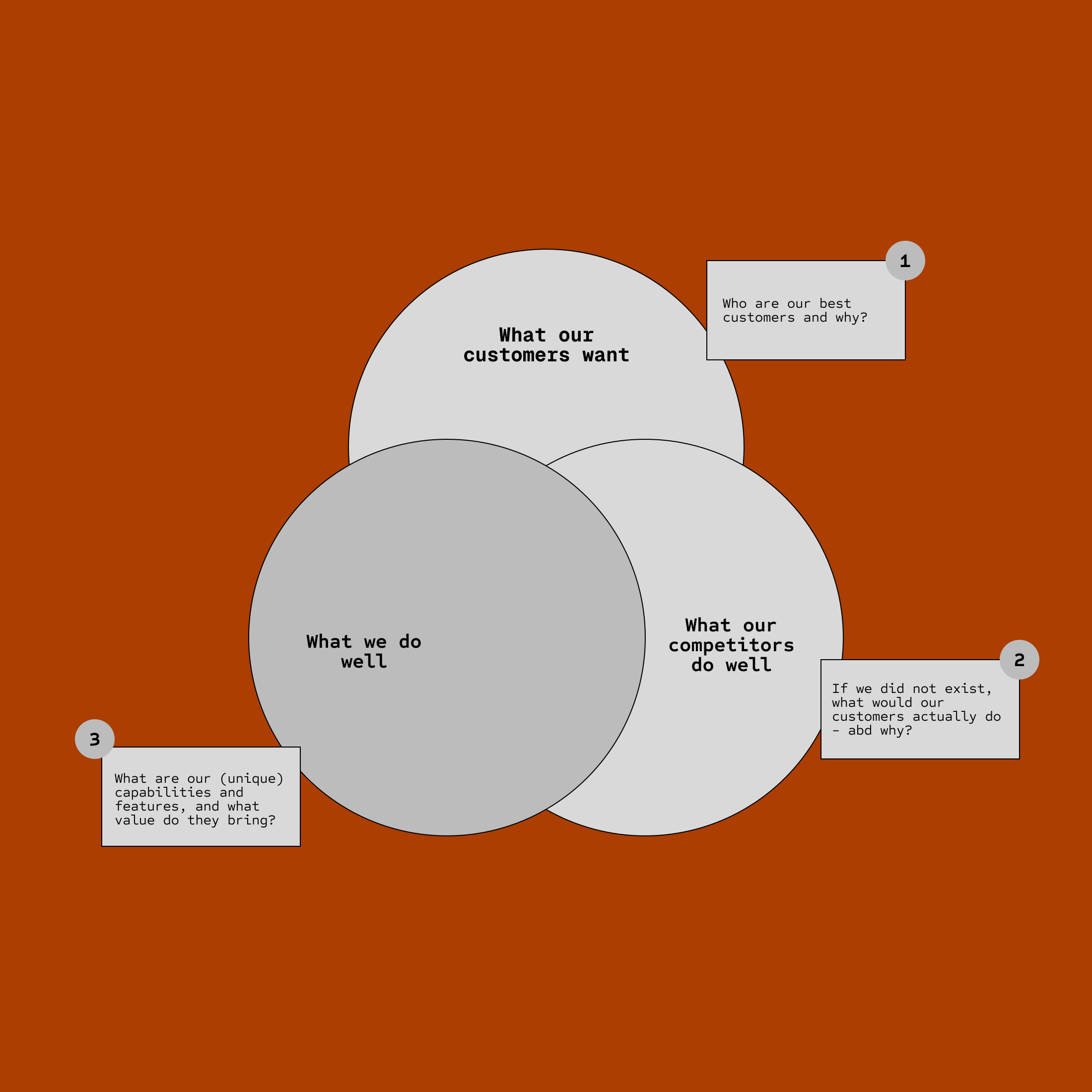
Your optimal value position lies in the intersection between what your ideal customers want, what our competition does well and what we do well. By understanding each part in detail, you will have a better understanding of how and why you can position your brand in the market.
"Venn diagram"


Step 1: Ideal customer profile
Who are your customers and why?
Describing and discussing your best customers is a great way to understand what patterns emerge to work towards profiling your most ideal customer type.
Approach
For each "good customer", describe:
Who they are, and include descriptors such as size, revenue, markets, industry, etc.
Their challenges in relation to what you offer, but also more broadly.
What they buy from us and could be buying from us.
Why it is a good customer. Is it because of the revenue they generate? Is it a good and collaborative relation? Are they a profile customer? Other?
Step 2: Competitive Alternatives
What would your customers use/do, if you did not exist?
It is important to think about what the competition is, beyond those you might consider your biggest competitors. Moving from talking about competitors to competitive alternatives increasingly allows you to put yourself in the shoes of your customer and consider all the options they may have. This includes doing it themselves or doing nothing at all; status quo can often be your biggest competitor.
Approach
For each competitive alternative, describe:
Who they are
Their strengths and weaknesses
Why they are a competitor; why they are a threat in the future
How/why we can beat them
How well do you know the market?
Do you know enough about your customers and competitors to define your value space with certainty? The clarification phase usually provides many questions as it does answers; and that is OK. It leaves you with hypotheses you can validate or reject through focused market research.
Step 3: Capabilities
What (unique) capabilities do we have and what value do they bring?
Get a comprehensive overview of everything you do and offer and relate it to the value you create for customers - you don't sell features, you sell value - but the value comes from your features, so you need to understand the context.
Approach
Describe all the skills, products, solutions, etc., that your offers
Ensure to include everything from specific concepts and solutions to additional services, processes, methods, etc.
For each, try to answer "why is it valuable" for our customers.
Simplify
Consolidate into a clearly defined brand position
Moving from reflections to synthesis requires you to make strategic choices. Analyzing patterns that has emerged from the clarification phase and potentially have them validated through external insights.
*Diagram*
Step 4: Value Space Manifesto
How do we describe our (unique) value space?
Combining your insights, you will now boil it down to a definition of your value space - unlocking your ability to define your positioning.
Approach:
Find the things that are most common - are there any patterns that emerge and can we boil it down to some short precise descriptions of:
Who are our ideal customers? (repeated)
What is the general problem driving the market/customers?
What are the problems (for customers) with the alternatives in the market?
What is our solution/why are we a solution?
What is outcome and what is its value?
Step 5: Brand House
How do we describe our brand?
A strategic foundation must be easy to understand and easy to grasp, it must be explained "on a page".
Approach:
Translate the manifesto into a one-page "brand strategy" by consolidating the insights in a more simplified way, describing:
Your position (who are we, what category do we play in, and what overall value do we offer - i.e. what can our customers buy and "why should they care").
Value proposition that supports this position
Relevant proof points that are the evidence for customers to believe what we say
Amplify
Translate into customer-relevant messages
One place to start is to put it into practice and generate and capture leads. This means that we need to have a content framework in place, that covers our value proposition and the customer journey. From your brand house, you have already defined a set of value propositions that carries your positioning, so now you need to understand how these can provide and prove value across the customer journey – starting out in principle terms.
Step 6: The Customer Journey
What can help our potential customers along the customer journey?
Start by identifying the overall stages of the customer journey that may be relevant (a simple example can be seen below). By asking the most typical questions that customers may (subconsciously) have along the journey, you can identify the most obvious needs that we subsequently should cater to in our content framework.
Approach:
Lean on the guiding questions, but most importantly, use your organization to understand what touch points we have with customers and what they demand at different times. Ideally, of course, involve customers here - both existing and potential - either through interviews, focus groups, surveys or similar.
Guiding questions:
What can capture the customer’s interest?
What is the customer typically unsure about in the category?
What is unclear to the customer in terms of solution and product options?
What is the most crucial factor when making a purchasing decision?
Step 7: Content Framework
How can we activate our brand through the customer journey?
With a content framework, you are now bridging the gap between brand strategy and practical execution related to the stages of the customer journey. The content framework makes it easier to execute consistently and coherently in line with brand and customer journey and with a structured approach you have a feedback loop into what resonates with customers.
Approach:
Based on the reflections from the customer journey, write down all the themes that come to mind within each intersection of the customer journey stage and your defined value propositions. This can be anything from proof points, content, information and other assets.